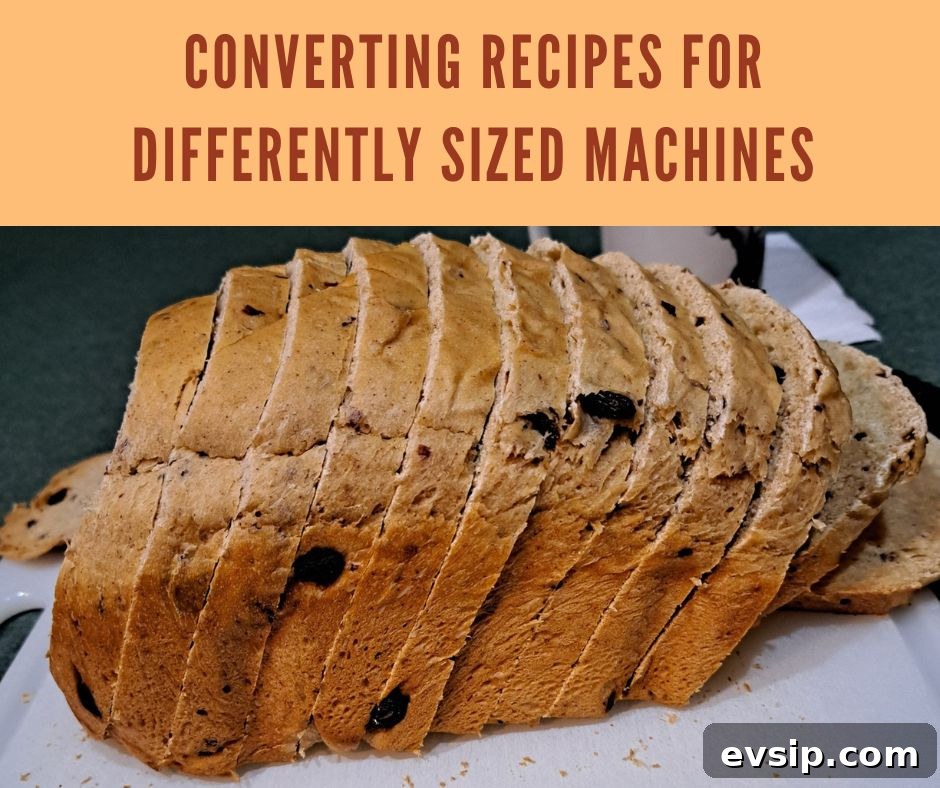
Bread machines come in different sizes. I’m often asked how to adapt recipes for machines of different loaf capacities.
Last Updated January 22, 2026 – Originally posted January 2, 2017
Featured Comment
This page has been the most help I’ve found for conversions. ~ Patricia
I own three different bread machines and I use my two-pound machines the majority of the time. Consequently, most recipes here are written for two-pound loaves. Because bread machines vary in capacity, converting a recipe from one loaf size to another is a common need. The good news is that you can convert with simple math and a little trial-and-error.
How do I convert a two-pound loaf recipe to another size?
Start by scaling each ingredient proportionally. If a two-pound recipe calls for 4 cups of flour and you want a one-pound loaf, divide that amount by two and use 2 cups. Apply the same division to all ingredients—liquids, salt, sugar, fats and yeast.
For a 1.5-pound loaf, the math requires one more step. Divide the two-pound ingredient amounts by four to get the amount per half-pound, then multiply by three to get amounts for 1.5 pounds. For example: 4 cups of flour ÷ 4 = 1 cup per half-pound; 1 cup × 3 = 3 cups of flour for a 1.5-pound loaf.
Expect to round some measurements—especially small quantities like salt or spices. Make your best rounded choice and write everything down before you start. Keeping accurate notes will save time and frustration when you refine the recipe.
Always double-check the converted yeast amount. If the scaled yeast seems unusually high or low compared to typical recipes for that loaf size, adjust the yeast slightly up or down. Yeast affects rise and texture more than many other ingredients, so small adjustments can make a big difference.
What about the eggs?
Eggs deserve special attention when reducing a recipe. If the original calls for an odd number of whole eggs, beat the eggs together and measure the beaten volume instead of dropping in whole eggs. For instance, if a recipe uses 3 large eggs and you are converting to a smaller loaf that needs about half of that volume, beat the 3 eggs and use roughly half of the beaten mixture (about 1½ eggs’ worth). The leftover beaten eggs can be used for scrambled eggs or French toast.
Measuring beaten eggs by volume keeps the liquid balance consistent. Simply omitting whole eggs or rounding down too far can reduce liquid content and affect dough consistency and rise.
When you make your converted recipe for the first time
Follow the order of ingredient placement recommended by your bread machine’s manual. After the machine begins kneading, check the dough at about five to ten minutes. The dough should form a smooth, round ball that clears the sides of the pan and rotates freely.
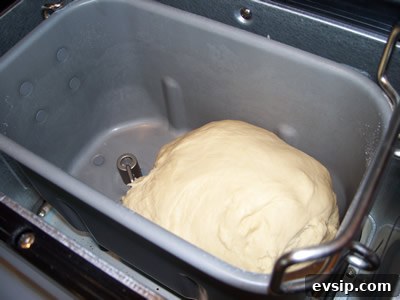
Smooth, round ball of dough
If the dough looks too dry and crumbly, add liquid a teaspoon at a time until it gathers into a ball. If it’s too wet and sticky, add flour a teaspoon at a time until the dough becomes smooth and elastic. Keep detailed notes of any adjustments so you can reproduce successful changes in future batches.
Tweaking the recipe
It’s common to need two or three trials to perfect a converted recipe. Be patient and systematic: change one variable at a time and record the result. Here are practical troubleshooting tips based on common issues:
- Loaf rose too much: Consider reducing the yeast slightly, reducing liquid or sugar, or increasing salt a bit. Any of these changes will slow fermentation.
- Loaf didn’t rise enough: Try reducing the salt, or increasing the yeast, liquid or a small amount of sugar to feed the yeast.
- Top of the loaf cracked: This can indicate too much flour or too little liquid; try slightly less flour or more liquid.
- Crust too dark: Increase the liquid by one to two tablespoons or try a lighter crust setting if your machine has one.
Beyond these basic adjustments, ingredient quality and ambient conditions (temperature and humidity) affect dough behavior. Warmer kitchens speed fermentation; colder kitchens slow it. Flour brands absorb water differently, so water amounts that work with one flour might need tweaking with another.
In summary: scale ingredients proportionally, measure beaten eggs by volume when needed, check dough early in the kneading cycle, and make small, recorded adjustments. With a few attempts and careful notes, you can adapt two-pound recipes to one-pound, 1.5-pound, or other sized bread machines and consistently produce excellent loaves.